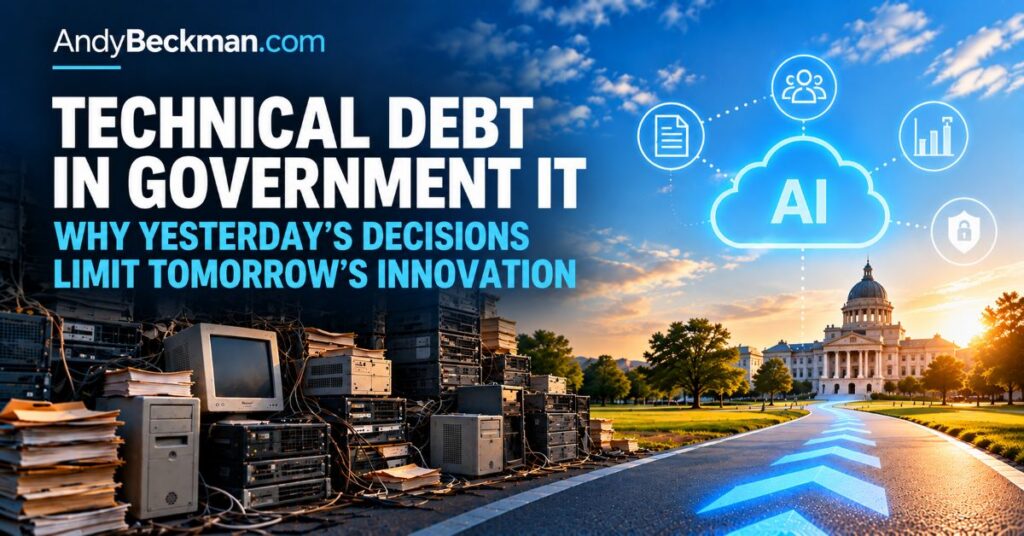
The biggest cost of technical debt is not always keeping old technology alive. It is what that old technology prevents you from doing next.
The Technology Works. So What’s the Problem?
One of the hardest technology problems to explain is a system that still works.
The server is running. The application opens. Employees can create documents and send emails. Nobody is standing outside the CIO’s office demanding that it be replaced. From an operational perspective, everything may look fine.
That is exactly how technical debt can quietly accumulate for years.
Technical debt is often discussed in software development as the future cost created by taking shortcuts today. For a CIO or CTO, I think the definition needs to be broader. Technical debt is the accumulated impact of technology decisions that make tomorrow’s choices harder because of yesterday’s architecture.
That can be an aging server, unsupported software, an old licensing model, a file share nobody wants to touch, a legacy application that traps data, or a business process built around technology that should have been retired years ago.
The important point is that none of those things has to be broken.
In fact, technical debt doesn’t always look like failure. Sometimes it looks like stability.
How Government Budget Cycles Create Technology Debt
Local and small governments are particularly susceptible to this because technology lifecycles and government budget cycles do not naturally line up.
Technology leaders think in three-, five-, and ten-year horizons. Budgets are generally built one year at a time.
An organization gets funding for a server, storage platform, application, or other technology it needs today. The purchase gets made, the problem goes away, and attention shifts to the next priority.
Three or five years later, that original technology is aging, but there is not necessarily replacement money waiting for it. There is another urgent project competing for those dollars. So the organization stretches the lifecycle another year. Then maybe another.
Do that across dozens or hundreds of systems, and eventually you have an environment in which a significant amount of technology is aging at the same time.
Each individual decision may have looked financially responsible. Collectively, those decisions create debt.
This is not just a local government problem. The U.S. Government Accountability Office reported in 2025 that federal agencies planned to spend about 79 percent of fiscal-year 2025 IT dollars on operations and maintenance. GAO also identified critical legacy systems that use outdated languages, rely on unsupported hardware or software, or operate with known cybersecurity vulnerabilities.
For a new technology leader, there is an important lesson here: your budget may be annual, but your technology strategy cannot be.
That is part of the difference I have written about between managing today’s operations and providing long-term technical leadership.
The Hidden Cost Is Opportunity
Maintenance cost is the easy part of technical debt to see. Old systems may cost more to support. They can create security concerns, compatibility issues, help desk calls, downtime, or dependence on specialized knowledge.
But I think the more damaging cost is often opportunity.
A system may still perform exactly the function for which it was purchased. The problem is that the organization now wants to do something that nobody imagined when that system was purchased.
Maybe the data cannot easily be accessed. Maybe the system cannot integrate with a modern platform. Maybe the licensing model is wrong. Maybe the infrastructure cannot scale. Maybe adding the new capability requires replacing three other things first.
That changes the question, I think IT leaders should ask.
Instead of only asking, “Is this system still working?” ask, “What are we unable to do because this system exists in its current form?”
Technical debt doesn’t just make yesterday’s technology harder to maintain. It can prevent you from adopting tomorrow’s technology.
Microsoft 365: When “It Works” Is Not Enough
I saw this firsthand when I stepped into my current role.
We had Microsoft licensing and the normal Office products people needed. Employees had Word. They had Outlook. They could write documents and send emails. But much of the environment was ten to fifteen years behind current technology.
If the standard were simply whether people could perform the basic function, there would be no emergency.
The challenge was that moving an agency of roughly 900 people to Microsoft 365 represented a meaningful cost. Looking only at the immediate function, it was reasonable for someone to ask why we should spend that money when everybody already had Word.
But “having Word” was not really the objective.
Moving to a common modern platform reduced compatibility problems and user friction. People were working with consistent versions of the tools. We could move away from old templates and odd workarounds. It also gave us collaboration, security, cloud, and integration capabilities that did not exist in the old model.
Most importantly, it created a foundation for things we had not originally purchased it to do.
That has become much more obvious with the explosion of AI.
AI Is Exposing Technical Debt
Every organization is now talking about artificial intelligence. But one of the lessons I think many organizations are learning is that buying an AI tool does not suddenly make the organization AI-ready.
AI is only as useful as the information it can securely and appropriately work with.
If years of organizational knowledge are scattered across local hard drives, old file servers, disconnected applications, network shares, and systems that cannot be indexed or integrated, you have another problem to solve before AI can deliver much value.
Our cloud-first direction has changed that equation. We use Microsoft Copilot. What interests me is not simply asking an AI generic questions. I can already do that with public AI tools. The real value is when the technology can work with my organizational context.
Meetings can be transcribed and summarized. Action items can be captured. Documents, emails, meeting content, and other information can serve as context for future work, subject to the permissions already governing that information. Microsoft’s documentation explains that Copilot can ground responses in organizational data such as documents, email, chats, meetings, and calendars through Microsoft Graph, while only surfacing organizational information the user has permission to access.
Now imagine I need to write a briefing or develop a proposal in six months. The useful context may not be a random article on the internet. It may be an email chain from February, a Teams meeting from April, and a document we created in June.
That becomes possible because we first did the much less glamorous work of modernizing the environment underneath it.
This is why AI readiness is becoming another lens for assessing technical debt. An organization can have no outage, no broken server, and no immediate crisis while still being years away from taking advantage of current technology.
From Big Purchases to Variable Capacity
There is another part of this transition that matters for technology leaders: the way we buy capacity.
Traditional infrastructure required us to predict the future and purchase for it.
How much compute will we need? How much storage? What will peak demand look like? What will growth look like three years from now? Then we bought enough physical infrastructure to cover the forecast.
At a previous organization, I was involved in buying Oracle infrastructure, where we effectively purchased a larger physical platform and licensed it down to a fraction of the rack we needed. The equipment was physically there, but software and licensing controlled how much of it we could actually use.
We had paid for capacity we did not need, because that was how the model worked.
A cloud or virtual model changes that. It does not automatically make technology cheaper, and I think IT leaders make a mistake when they sell cloud solely as a cost-reduction strategy. Cloud can absolutely become expensive if it is poorly governed.
The more interesting benefit is flexibility.
The NIST definition of cloud computing identifies rapid elasticity and measured service as core cloud characteristics. In practical terms, that means I can provision capacity when I need it, increase it as demand grows, and reduce it as requirements change.
That levels out some of the huge spikes created by traditional hardware refresh cycles and, more importantly, gives me more options.
Agility Means Making Smaller Bets
This is where the conversation moves beyond the cloud and becomes a conversation about agility.
In the traditional on-premises world, trying something new could mean a major purchase, procurement, installation, configuration, integration, and months of work before you knew whether the idea actually solved the problem.
You could be a year into a project before realizing that what you specified a year earlier was no longer quite what you needed. By then, you had a lot of sunk costs and a very strong incentive to make the original decision work.
I would rather create an environment where we can make smaller bets.
If I think a technology might solve a problem, I would much rather spend $5,000 testing that assumption than spend $1 million proving I was wrong.
Build a minimum viable product. Test it. Learn from it. Modify it. If it works, scale it. If it does not, turn it off and move on.
That is agility in a broader sense than in an Agile software development methodology. It is organizational agility—the ability to learn while decisions are still inexpensive and reversible.
It also does not mean chasing every shiny object. I have written before about using a True North to avoid distractions as a technical leader. The point is not to experiment with everything. The point is to make it practical to experiment with what actually aligns with your strategy.
Spending Taxpayer Dollars Wisely
This matters in government because we are spending taxpayer dollars.
I do not think taxpayers particularly care whether a server is old or new. They care that the government spends their money wisely and delivers the service it is supposed to deliver.
Keeping old technology forever is not automatically a fiscal responsibility. Neither is moving everything to the cloud, buying the newest product, or launching every AI pilot that comes along.
Good stewardship means understanding total cost, risk, capability, and future value.
Sometimes that means keeping a perfectly functional older system. Sometimes it means spending money now to avoid a much larger problem later. And sometimes it means spending a small amount to test an idea before asking the organization to make a major commitment.
That last option is one of the reasons I value agility. A $5,000 proof-of-concept that tells us not to proceed may be an excellent use of taxpayer money.
Five Things Every New CTO Should Be Thinking About
When you step into a senior technology role, you inherit years of decisions you did not make. You cannot fix all of them at once, nor should you try.
But there are five things I think every new CIO, CTO, or IT director should start doing early.
1. Inventory the Debt, Not Just the Assets
An asset inventory tells you what you own. A technical-debt inventory should tell you what is holding you back.
Look at lifecycle, support status, security, licensing, ownership, data location, integrations, dependencies, and institutional knowledge. Pay particular attention to systems that other systems depend on. Those are often where a seemingly small piece of technical debt has an outsized impact.
2. Build a Three-to-Five-Year Roadmap
Your finance department may work on one budget year at a time. You still need to show what is coming three to five years out.
Map major lifecycle events, end-of-support dates, replacement cycles, and strategic investments. Give stakeholders time to understand the problem before you need the money. A replacement request is easier to discuss when it has been visible on the roadmap for three years than when a vendor announces end of support six months before budget season.
3. Prioritize Investments That Create Options
Some purchases solve one problem. Others make ten future projects possible.
Identity, connectivity, cloud architecture, collaboration platforms, security, data governance, and integration capabilities can enable investments. They may not always be the exciting project, but they create the foundation that lets the exciting project happen later.
That is a core part of technical leader responsibilities: connecting individual technology decisions to the longer-term direction of the organization.
4. Make Experimentation Cheap
Create a way for your team to run controlled proofs of concept without turning every new idea into a major procurement exercise.
Give the experiment a hypothesis, budget, owner, time limit, and definition of success. Then be willing to stop.
Killing a small experiment that did not work is not a failure. It may have prevented a much larger failure.
5. Measure Technical Debt by What It Blocks
Age is useful information, but age alone should not determine priority.
A ten-year-old system that is secure, supported, inexpensive, and meets every requirement may be less urgent than a five-year-old system that traps critical data or prevents a strategic integration.
Ask what the debt is costing you today, but also ask what it is preventing you from doing tomorrow.
Build an Environment That Lets You Change Your Mind
The objective is not modernization for modernization’s sake.
Not everything belongs in the cloud. Not every legacy system needs to be replaced immediately. Not every new AI product deserves a pilot.
The objective is optionality.
A strong technology environment gives an organization choices. It lets leaders test an idea without betting the farm. It allows capacity to change when demand changes. It makes organizational information more usable. And it reduces the number of times the answer to a good idea has to be, “We can’t do that until we replace three other things first.”
No CTO can accurately predict every technology that will matter three or five years from now. We do not need to.
What we can do is deliberately reduce the technical debt that limits our choices and build an environment that can adapt when the next opportunity arrives.
Your job is not merely to keep today’s systems running. It is to build an environment where tomorrow’s decisions do not require undoing yesterday’s architecture first.